
Exosome hair treatment in the Maldives
A non-surgical regenerative therapy in Maldives that delivers concentrated growth-factor signals to the scalp to reactivate dormant follicles and improve density, ideal for early-to-moderate thinning.
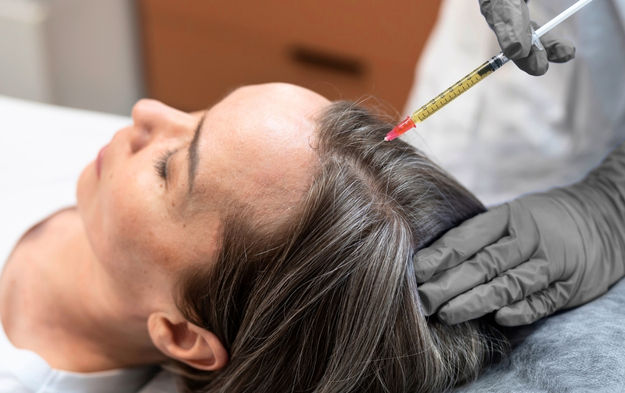
How exosomes work
Exosomes are biological messengers carrying growth factors that tell follicles to move back into an active growth phase and calm the inflammation that drives thinning. They wake up living but underactive follicles; they are not a transplant.
The course and what to expect
Delivered by fine micro-injections, often with a microneedling pen, over about 45 to 60 minutes with almost no downtime. A typical course is three to four sessions four to six weeks apart, with density clearest around the three-month mark and maintenance afterwards.
Who it suits
- Early-to-moderate male or female pattern thinning
- Postpartum or stress-related shedding
- Diffuse thinning without distinct bald patches
- Optimising results before or after a transplant
How exosomes support hair recovery
Exosomes are cell-derived signalling particles rich in growth factors and micro-RNA that, when applied to the scalp after microneedling, help wake up dormant hair follicles and calm the low-grade inflammation that often underlies thinning. They are typically used as part of a course alongside GFC or PRP, and patients in humid climates often see added benefit because exosome therapy also supports a healthier scalp barrier against sweat- and heat-related irritation.
Exosome hair treatment Maldives: cost and booking in Hulhumalé
Dr. Alaa Zidan offers exosome hair treatment in the Maldives at Life Care Medical Center in Hulhumalé, a short drive from Malé. The cost depends on the area of thinning, the number of sessions and the exosome product used, and the full figure is explained at consultation before anything is booked.
Exosome hair treatment cost depends on the area and the number of sessions, and because exosomes are a newer option, the price is weighed against PRP and GFC, which have a longer track record. For the step-by-step background before you book, read our exosomes for hair guide, or send Dr. Alaa a photo and your question on WhatsApp.
What results look like over time
There is no visible change in the first few weeks; density improvements typically build gradually and are most noticeable around month 4-6.
Often paired with
Often paired with a broader hair-scalp restoration plan rather than used entirely on its own.
Who might want to wait
If your hair loss is sudden, patchy, or accompanied by scalp pain or scarring, this should be medically assessed first, since it may point to a condition that needs a different kind of treatment entirely.
Common myth
“Will I see results after one session?” – No single session is enough. This is a biology-led process that needs a full course, usually 3-4 sessions, to give the follicles a real chance to respond.
Further reading
- Hair Restoration Cost in the Maldives: PRP, GFC and Exosomes Compared
- GFC vs PRP vs Exosomes for Hair: Choosing the Right Regenerative Treatment
- Clinic Update: Evening Hours, Skin Boosters and Exosome Hair Therapy
- Exosomes for Hair Loss: A New Generation of Regenerative Care
- Microneedling with Exosomes: A Combined Approach
- Exosome Hair Therapy: Who Is a Good Candidate
Not sure if Exosome Hair Treatment in the Maldives is right for you?
Send a few details and Dr. Alaa will get back to you personally on WhatsApp or email, no obligation.
This page is for education and is not a substitute for personal medical advice. Suitability, risks and results are assessed at consultation.
Related treatments
Frequently asked questions
What are exosomes for hair loss?
Exosome therapy delivers concentrated growth-factor signalling molecules to the scalp, encouraging thinning follicles back into an active growth phase without surgery or downtime.
Do exosomes really work for hair loss?
For early-to-moderate thinning where follicles are still alive, results are often impressive. They will not regrow long-established bald areas.
How is exosome therapy different from PRP?
Exosomes are lab-derived and standardised with a higher growth-factor concentration and no blood draw. Both work; exosomes tend to act faster.
How many sessions will I need?
A typical course is three to four sessions four to six weeks apart, with maintenance afterwards.
Is exosome therapy FDA-approved for hair loss?
No exosome product currently holds full regulatory approval specifically for hair restoration anywhere in the world. We use it as a physician-directed, evidence-informed option and explain that honestly at consultation, rather than presenting it as a guaranteed or fully approved cure.
Will exosomes regrow hair on a bald patch?
Generally no. If the follicle is gone there is nothing to reactivate; it works best for thinning, not long-standing baldness.
When will I see results?
Reduced shedding often within a few weeks, with visible density clearest around the three-month mark.
How long do exosome hair results last?
Results build gradually over a course of sessions and are typically maintained with periodic top-ups every several months, since hair growth cycles continue to turn over after treatment.