Exosomes for Hair Loss in the Maldives — A New Generation of Regenerative Care
Exosomes are one of the most genuinely effective non-surgical hair restoration tools available right now. Here's how they work, who they suit, and how the Maldivian climate fits in.
By Dr. Alaa Zidan · Medically reviewed April 2026
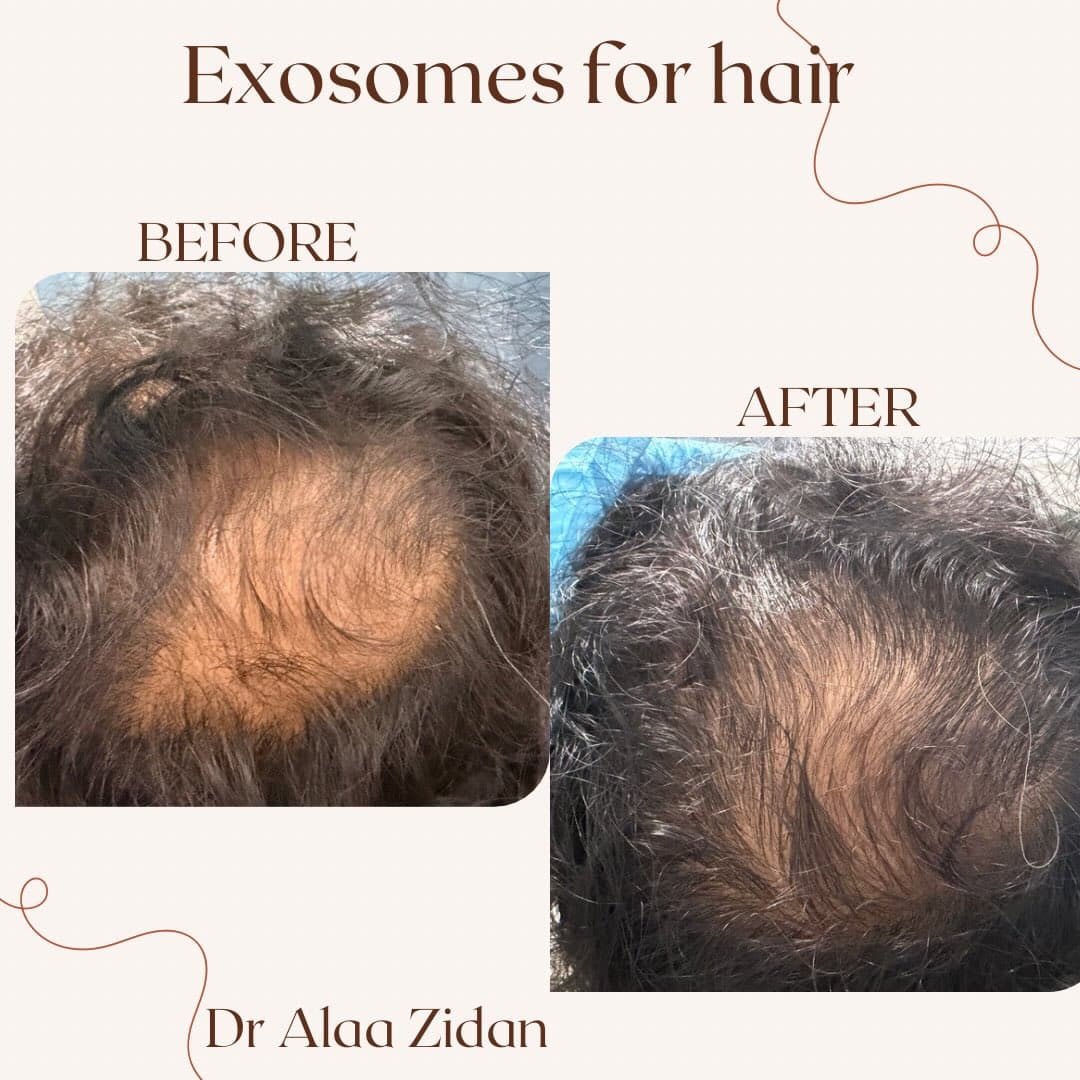
Exosomes are one of the most interesting developments in regenerative aesthetic medicine in the past decade — and one of the most genuinely effective non-surgical options we offer for early-stage hair loss in the Maldives. Patients ask about them constantly, often without quite knowing what they are. This guide explains what they are, who they suit, and how they fit with the realities of living in a tropical climate.
What are exosomes?
Exosomes are tiny extracellular vesicles — natural biological messengers that cells use to communicate with each other. They carry growth factors, proteins, lipids, and signalling molecules that tell surrounding cells what to do: divide, mature, repair.
In aesthetic medicine, we use lab-derived exosomes (typically isolated from mesenchymal stem cells) to deliver those signals directly to the scalp. Once introduced, they activate dormant hair follicles and stimulate new growth. It's not a transplant. There's no surgery. And the results, in the right candidate, are genuinely impressive.
How do exosomes treat hair loss?
Hair follicles cycle through growth, rest, and shedding phases. In progressive hair loss, more and more follicles get stuck in the resting phase and produce thinner, shorter strands until they stop producing visible hair at all (a process called miniaturisation).
Exosomes deliver growth-factor signals that push miniaturised follicles back into the active growth phase. They also reduce local inflammation around the follicle, which is one of the underlying contributors to pattern hair loss. The combined effect — anti-inflammatory plus pro-regenerative — is what makes the treatment more effective than first-generation regenerative options.
How does an exosome session work?
After a careful scalp assessment, exosome solution is delivered into the affected areas — usually via fine micro-injections placed across the scalp, sometimes paired with a microneedling pen to ensure even depth and absorption. Sterile single-use needles. Pharmaceutical-grade product. No anaesthesia, beyond a brief application of topical numbing cream if requested.
The whole treatment takes 45–60 minutes. There's almost no downtime; most patients walk out and continue their day. Mild scalp tenderness for 24 hours is normal — paracetamol handles it if needed.
Who is a good candidate for exosome hair therapy?
Exosomes work best for patients with early-to-moderate thinning rather than long-established baldness. The follicles need to still be alive — exosomes wake them up; they don't replace what's already gone. We see consistent results in:
- Early male and female pattern hair loss (Norwood 2–4, Ludwig 1–2)
- Postpartum or stress-related shedding (telogen effluvium)
- Diffuse thinning where overall density has dropped without distinct bald patches
- Patients wanting to optimise results from a hair transplant
- Stress-driven thinning common in expat residents and high-pressure jobs
- Alopecia areata in stable phase, as part of a combined treatment plan
How do exosomes compare with PRP?
Both are regenerative, both use the body's own healing signals — but the source and consistency are different.
PRP (platelet-rich plasma)
PRP is made from your own blood, drawn at the time of the appointment, spun in a centrifuge to isolate the platelet-rich layer, and re-injected. It's affordable, well-tolerated, and effective for many patients. The drawback: concentration varies with the donor's blood, and the active growth-factor content is naturally lower than concentrated exosomes.
Exosomes
Exosomes are lab-derived, pharmaceutical-grade, and standardised — every vial contains the same potency. No blood draw. The growth-factor concentration is many times higher than PRP, which is why patients often notice results faster.
Both work. Exosomes act faster and more predictably in our experience; PRP remains a sensible choice when budget is the deciding factor.
How many sessions will I need?
A typical course is 3–4 sessions spaced 4–6 weeks apart. After the initial course we maintain with one session every 3–4 months for 6–12 months, then a top-up every 6 months indefinitely if you want to hold the result.
Most patients notice reduced shedding within 2–4 weeks. Visible density improvement is clearest at the 3-month mark, with full impact at 6 months as the new follicles mature. We always take baseline scalp photos at consultation so you can see the difference over time.
Are exosomes safe?
Yes, when performed by a medical professional with pharmaceutical-grade product. Side effects are minimal: mild scalp tenderness for 24 hours, occasional pinpoint bleeding at injection sites, and rarely transient redness. There is no systemic absorption to worry about, no anaesthesia risk, and no recovery time.
We don't proceed if you have active scalp infection, certain autoimmune scalp disorders in active phase, untreated bleeding disorders, or are pregnant. Every patient is screened at consultation.
Does Maldivian climate affect hair loss or treatment?
Yes — both in how visible hair thinning becomes, and in what the scalp needs after treatment.
Sun bleaching and scalp ageing
Constant equatorial UV doesn't directly cause pattern hair loss, but it makes existing thinning more visible. Sun bleaches the strands you do have, making them look thinner against a scalp that may also be sun-tanned. A wide-brimmed hat for outdoor work is the simplest, cheapest scalp-care upgrade we recommend.
Sea, pool, and the lipid barrier
Daily swimming — common in expats and resort staff — strips the natural lipid coating from the hair cuticle. The strands appear drier, lifeless, and break more easily. Combine that with chlorine in pool water and you get cumulative cuticle damage that exaggerates the visual impact of any thinning.
A simple fix: rinse with fresh water immediately after swimming, then a light leave-in conditioner. We give every exosome patient a basic Maldives scalp-care routine alongside the course — it's not a separate service, just sensible adjacent care.
Postpartum shedding in the Maldives
Postpartum telogen effluvium — the heavy hair shedding that typically starts 3–4 months after delivery — usually self-resolves within 6–12 months. But in our practice, mothers who are also dealing with humidity-driven scalp irritation and sleep deprivation often see incomplete recovery without intervention.
Exosomes are particularly satisfying for these patients: they're safe (no systemic absorption), accelerate the return to baseline density, and reduce the prolonged shedding phase.
How much do exosomes cost in the Maldives?
Pricing varies by area treated (entire scalp vs. localised patches), product brand, and whether you book single sessions or a full course. Course pricing is meaningfully better than booking sessions individually. We share an exact quote on WhatsApp once we understand the scope.
How do I know if exosomes are right for me?
Start with a few photos. Most candidacy decisions can be made from clear, well-lit images of the hairline, crown, and parting line — sent on WhatsApp. We'll come back with an honest answer about whether you're a good candidate and a recommended plan.
If exosomes aren't right (for example, if the follicles in the area you care about are no longer viable), we'll tell you directly and recommend a more appropriate next step.
Booking exosome therapy in the Maldives
Exosome therapy is performed at Life Care Medical Center, Hulhumalé, by Dr. Alaa Zidan. To check whether you're a good candidate, message us on WhatsApp at +960 793 7512 — a few photos of your hairline and crown are usually enough to start. Same-day reply.
For more context on the wider treatment menu, see our pillar guide on aesthetic dermatology in the Maldives.
Frequently asked questions
Are exosomes a transplant?
Will exosomes regrow hair on completely bald areas?
How is it different from PRP?
Is it safe?
Does Maldivian humidity affect the result?
Sources & further reading
- Park BS et al. Stem-cell-derived exosomes for hair growth — review. PMC.
- AAD — Hair loss types and treatments
This article is for educational purposes and is not a substitute for personal medical advice. To discuss your skin and treatment options, please book a consultation.
Part of our pillar guide
Aesthetic Dermatology in the Maldives — The Complete Guide
A clinical guide to aesthetic dermatology in the Maldives: what treatments work for Maldivian skin and climate, what to expect, how to choose, and how to plan care that respects the sun and salt of island life.
Read the complete guide →Join the conversation
Comments & questions
Leave a question or share your experience. Dr. Alaa's team reads every comment and replies personally. Sign in once with GitHub to post — your comment appears here for other readers and is emailed to the clinic for a personal follow-up.
Prefer a direct conversation?
Same-day replies on WhatsApp and Instagram.