Fractional Laser Sessions: How Many You Need and How Far Apart
 By Mahmoud Mohamed Samir · Published 13 November 2026 · 9 min read
Key takeaways
- Fractional laser sessions are usually planned as a course, because collagen rebuilds gradually and one treatment rarely does everything.
- How many sessions you need depends on the concern, the depth of treatment, the device and your skin tone, and is set at consultation rather than from a standard number.
- Sessions are spaced weeks apart so the skin can heal and remodel between them, and the gap matters as much as the count.
- Expect pinkness and light peeling for roughly three to five days after each session, with strict sun protection for the weeks that follow.
- Evidence supports real but partial improvement in acne scars and texture, not perfect skin.
Fractional laser sessions are the question we are asked most often after “does it work?”, and the honest answer is that it depends on what you are treating and how deeply the laser works. This guide explains how the number of sessions is decided, how far apart they are spaced, what each visit involves, and what the research says about results, so you can plan realistically before you book.
In the Maldives, year-round high UV and a life spent on and around the sea make timing part of the plan: the weeks after each session need strict sun protection, so we schedule treatment away from long beach days, boat trips and diving holidays, and deeper skin tones, which are common here, call for carefully chosen settings to limit pigmentation.
In short: fractional laser improves acne scars, texture and fine lines over a planned course of sessions, spaced several weeks apart. At our Hulhumalé clinic in the Maldives, Dr. Alaa Zidan, a dermatologist, sets the number and timing of sessions after examining your skin and discussing your goals.
How fractional laser sessions work
Controlled micro-injury, repeated
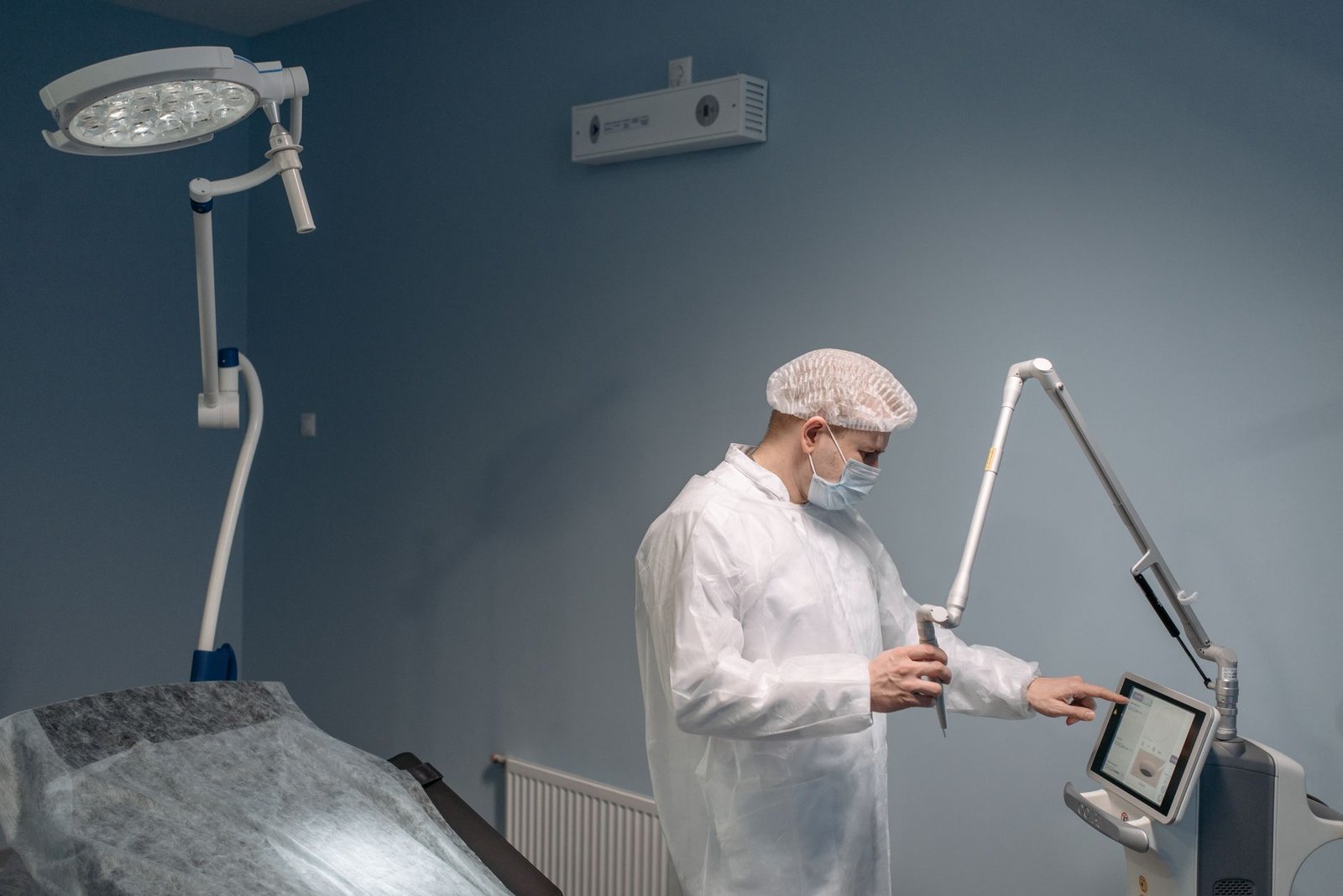
A fractional laser creates thousands of microscopic treatment columns across the skin while leaving the tissue between them intact. That controlled micro-injury triggers the skin’s own repair process, rebuilding collagen and smoothing texture over the following weeks. Because only a fraction of the skin is treated each time, healing is quicker than with older, fully resurfacing lasers, but it also means each session achieves a modest, partial change.
Why one session is rarely enough
New collagen takes weeks to form and months to mature, so the benefit of a session unfolds slowly after the treatment, not on the day. A course of sessions lets each round build on the last. For deeper concerns such as acne scars, repeating the stimulus is what produces a visible difference, which is why a single session is usually a starting point rather than the whole plan.
Want the full Treatment Guide?
A plain-language guide to choosing the right treatment, what downtime really looks like, and how to prepare for your first visit, unlocked instantly, no waiting.
How many fractional laser sessions you may need
Acne scars and uneven texture
Acne scars and rough texture usually need a course of sessions. In a systematic review of fractional CO2 laser for acne scars, which pooled seven studies, most patients experienced a 30 to 70 per cent improvement in the appearance of their scars, but the schedules in those studies varied. That variation reflects reality: protocols differ between devices, and a stronger ablative laser may use fewer sessions with longer gaps, while a gentler non-ablative laser is often given as a longer series. For an overview of the options, see our guide to the best treatment for acne scars.
Fine lines, enlarged pores and dullness
For fine lines, enlarged pores and general dullness, a smaller series is often enough to see smoother, brighter skin, with occasional maintenance sessions later if you wish. These concerns respond to lower-intensity treatment, so recovery is gentler and there is less to wait out between visits.
Mild pigmentation alongside texture
Where mild pigmentation sits alongside texture concerns, fractional laser can be part of the plan, but pigment problems such as melasma can be sensitive to heat and light, so settings are chosen conservatively and the plan may be built around other treatments as well. We would rather take more sessions at gentler settings than push a single strong one.
A realistic way to plan
Rather than promising a number up front, we usually agree a starting series, review your skin and photographs together after a few sessions, and then decide whether to continue, change the settings, add another treatment or pause. For example, someone with shallow boxcar scars and rough texture might begin with a short series, assess progress at the midpoint, and then choose between more laser sessions and adding fractional radiofrequency. This review point keeps the plan honest and avoids paying for sessions that are no longer adding value.
How far apart to space sessions
Why the gap matters
Sessions are spaced weeks apart, because the skin needs time to finish healing and to lay down new collagen before it is treated again. Treating too soon risks irritation and pigmentation, and waiting too long can slow progress. Your own gap is set from how your skin recovers after the first session, and we adjust as we go rather than following a fixed calendar.
Planning around sun and travel in the Maldives
Strict sun protection is required for the weeks following each session, and the Maldivian sun is strong all year. We therefore plan the course around your travel, work on the water, weddings and holidays, and recommend a broad-spectrum sunscreen of SPF 30 or higher, applied generously and reapplied through the day. If you spend time on islands or boats, mention it at the start so that the schedule realistically protects the skin.
What happens at each session and afterwards
Each appointment takes roughly 45 to 60 minutes. Numbing cream is applied first, and you may feel warmth and a prickling sensation as the laser passes over the skin. Afterwards the skin looks pink and feels warm, similar to mild sunburn, with light peeling or a sandpaper-like texture for about three to five days as new skin comes through.
During this time we advise a gentle cleanser, a simple moisturiser and diligent sun protection, and avoiding picking or scrubbing the skin. Makeup and strong active products are best held back until the skin has settled. Our general overview of fractional laser resurfacing explains what you will see day by day in more detail.
What the evidence says about results
The research supports fractional laser as a useful treatment, with realistic limits. The CO2 review mentioned above concluded that fractional CO2 laser is effective and safe for acne scars, with the most common side effects being transient redness, swelling and post-inflammatory pigmentation that resolved within a few weeks, while also calling for more long-term follow-up studies.
For darker skin, an evidence-based review of non-ablative fractional lasers in skin of colour concluded that fractional resurfacing is a safe and effective option in Fitzpatrick skin types IV to VI. It found stronger evidence for acne, striae and skin rejuvenation, and moderate evidence for acne scars, melasma and surgical or traumatic scars, but noted a shortage of high-quality studies in the darkest skin types. In practice, that means treatment is possible, but caution, test settings and a dermatologist’s judgement matter.
Judging whether sessions are working is easier with a method: photographs taken in the same light and from the same angles before you start and at each review show change that a mirror hides, and your own sense of how the skin feels is a useful guide too. If improvement stalls, that is a reason to change the plan, not simply to repeat it.
Who should delay or avoid fractional laser
Fractional laser is not suitable during pregnancy, over active infection or a cold sore flare, or on skin that is freshly tanned or sunburned. Tell us if you have a tendency to keloid scarring, if you have recently taken oral isotretinoin, or if you use medicines that make skin more sensitive to light, because these change the timing and the risk. Active acne is usually calmed first, because a laser over inflamed skin can make irritation and pigmentation more likely.
Combining fractional laser with other treatments
Fractional laser is often one part of a combined plan. Narrow ice pick scars may be treated individually with TCA CROSS, pigment concerns with peels or targeted pigment care, and broader texture with laser or radiofrequency. Combining treatments is not simply doing more: they are sequenced, with enough recovery between them, so that the skin is never asked to heal from two strong treatments at once.
Fractional laser cost: what affects it
Fractional laser cost depends on the area treated, the treatment depth, and the number of sessions, and we do not quote a figure without seeing your skin. Because most concerns need a course, it is more useful to judge cost over the whole plan than per session, and to ask what is included, such as follow-up and aftercare advice. The full figure is explained at consultation before anything is booked.
Choosing a clinic for fractional laser in the Maldives
A good clinic will examine your skin before suggesting a course, explain how many sessions are likely and why, adjust settings for your skin tone, and be clear about downtime and sun protection. Be cautious of anyone who promises a fixed result in a set number of sessions.
Getting fractional laser in Hulhumalé
Dr. Alaa Zidan offers fractional laser in the Maldives at Life Care Medical Center in Hulhumalé, a short drive from Malé. For a step-by-step look at each visit, see our fractional laser guide. If you would like to talk through how many sessions might suit you, you are welcome to message us on WhatsApp for a calm, no-pressure chat.
Still deciding what's right for you?
Get instant access to the full Treatment Guide, concerns, downtime, aftercare, and what to expect at your first visit.
Frequently asked questions
How many fractional laser sessions do I need?
It depends on your concern, the device and your skin. Acne scars and rough texture usually need a course of sessions, while fine lines and dullness often need fewer. Your plan is set at consultation after an examination.
How far apart should fractional laser sessions be?
Sessions are spaced several weeks apart so the skin can heal and rebuild collagen between them. The exact gap depends on the device and how your skin recovers.
Can one fractional laser session be enough?
For mild concerns, one session can give a visible refresh, but acne scars and deeper texture usually need repeated treatment to build a meaningful change.
Where can I get fractional laser in the Maldives?
Dr. Alaa Zidan, a dermatologist, offers fractional laser at Life Care Medical Center in Hulhumalé, a short drive from Malé. A consultation comes first to plan your sessions.
Is fractional laser safe for darker skin?
Evidence reviews suggest fractional lasers can be a safe and effective option in darker skin types when settings are chosen carefully, though high-quality studies in the darkest skin types are limited. Strict sun protection afterwards reduces the risk of pigmentation.
Sources & further reading
- PMC: The Use of a Fractional Laser in Acne Scar Treatment – A Systematic Review
- PMC: Nonablative Fractional Laser Resurfacing in Skin of Color: Evidence-based Review
Mahmoud Mohamed Samir is a digital marketing specialist at BrightSeen Marketing Agency, the agency that runs this clinic’s Google search and AI search visibility (SEO and GEO), Meta Ads and website. Medical content is reviewed by Dr. Alaa Zidan.
This article is for educational purposes and is not a substitute for personal medical advice. To discuss your skin and treatment options, please book a consultation.
Have a question about this?
Send a photo and a short note on WhatsApp for an honest treatment recommendation from Dr. Alaa.